
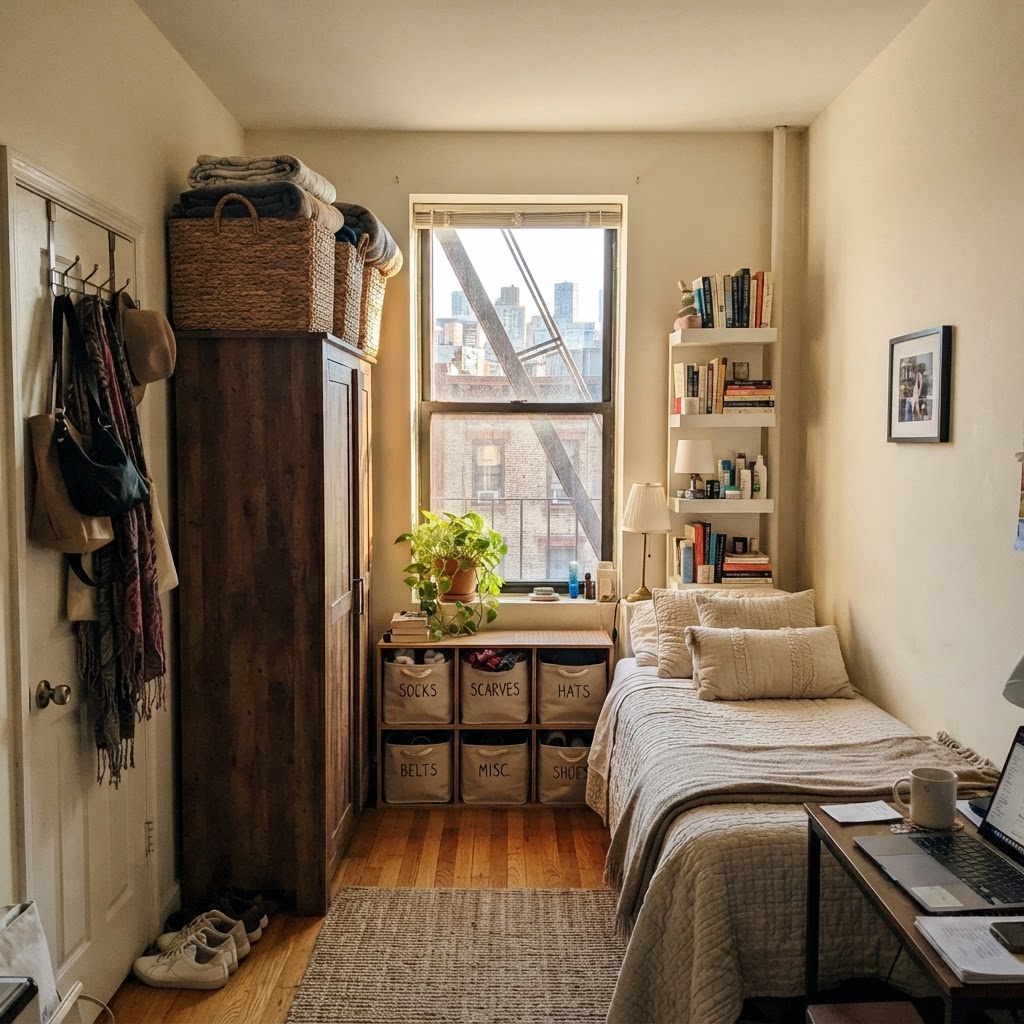
Why storage in a New York apartment is a different problem
Most storage advice is written for houses with garages and walk-in closets. A typical New York rental gives you 450 to 600 square feet, one closet with a folding door, and a radiator that cannot be blocked. The goal is not to buy more furniture. It is to squeeze more usable cubic feet out of the space you already pay for.
Three rules do most of the work:
- Vertical beats horizontal. Floor area is the expensive dimension here, wall height is nearly free.
- Anything used weekly has to be reachable without a step stool. Storage that needs a chair is storage you will avoid.
- Every organizing product needs a job. A bin that holds nothing is just clutter with a lid.
Measure before you buy anything
Write down five numbers before you order a single basket: closet interior depth and door swing; clearance under the bed; ceiling height in each room; distance from the radiator to the nearest wall; and the width of the narrowest doorway the item must pass through.
That last number matters most in brownstones and walk-ups. A shelf unit six inches too wide for a 28-inch doorway is a shelf unit you will return.
Bedroom: build layers instead of adding furniture
The under-bed layer
A queen bed covers around 33 square feet of floor. Put it to work with flat bins no taller than the clearance you measured, and choose bins with latching lids since New York dust finds everything. Floors in older buildings slope, so wheels matter more than handles.
Closets: stack instead of hanging
A single rod wastes the top two feet of a closet. Add a shelf above the rod for off-season items, then a second, lower rod for shirts when the closet is deep enough. Shoes go on a slanted rack at the bottom, not in a pile on the floor.
Behind and over doors
The back of a bedroom door holds a surprising amount: a shallow rack for belts and scarves, adhesive hooks for bags. Over-door racks work well on hollow-core doors, but keep the load light so the door still closes flush.
Bathroom storage that survives steam
Most New York bathrooms are five by seven feet with one medicine cabinet. Humidity destroys cardboard, suction cups fail on grout lines, and anything on the floor near the tub gets wet.
What holds up: a tension-pole corner shelf in the shower with rust-proof trays, a narrow rolling cart between the vanity and the wall if the gap is at least eight inches, a magnetic strip inside the medicine cabinet door for tweezers and clips, and stacking drawers inside the vanity rather than on the counter.
Skip fabric bins in the bathroom. They absorb steam, smell by March, and cannot be cleaned properly.
Hallway and kitchen: create a landing strip
Every apartment needs one place where keys, mail, bags and shoes land. A shallow console ten to twelve inches deep with two hooks above it handles most of it and keeps the walkway clear. If the entry is too narrow even for that, a wall-mounted mail pocket plus a single hook is enough.
In the kitchen, the vertical strip above the counter is usually wasted. A rail with hooks and a couple of small shelves turns it into storage without taking counter space.
Habits that keep the system working
Storage fails slowly. Set two recurring checks: a five-minute reset every Sunday, and a seasonal pass where anything unused for a year leaves the apartment. In New York, one bag out per season is the difference between a system and a storage unit you pay $200 a month for.
When to book help
Most of this is weekend work with a drill. Call a pro when the job needs anchors in plaster or brick, when a closet system has to be cut to fit, or when shelves have to carry real weight. Our handyman service handles shelving, closet rods and small installs by the hour, and furniture assembly covers the flat-pack pieces that usually start these projects.
FAQ
Do command hooks work on New York plaster walls? Sometimes, for light items only. Old plaster is often painted many times over and can release in a sheet. For anything heavier than a coat, use a proper anchor.
Is it worth building a closet system in a rental? A freestanding or tension-mounted system works well and comes out at move-out. Built-ins are rarely worth it unless you own the apartment.
How do I store things with no closet at all? Tall, narrow shelving in a corner plus under-bed bins covers most studios, and a small storage unit for seasonal items is cheaper than paying for a bigger apartment.