
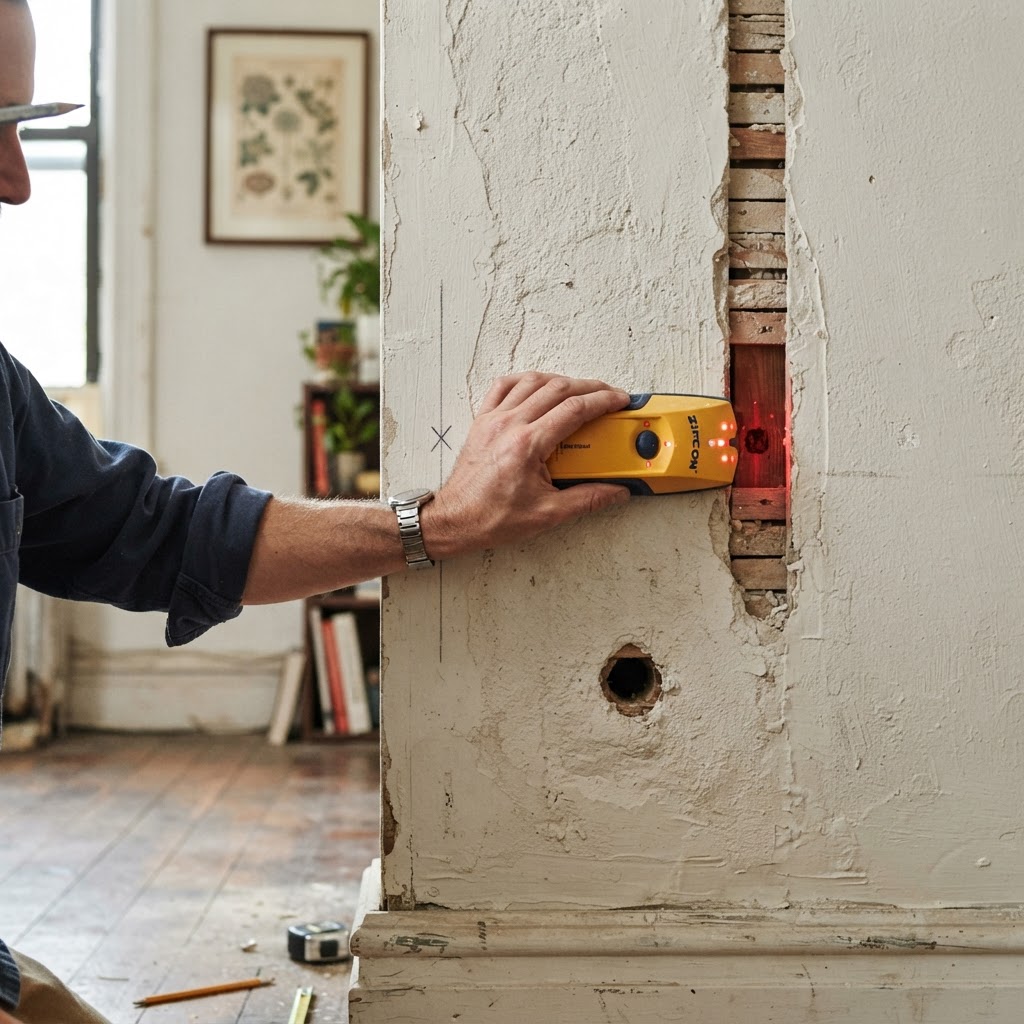
Finding structural support in a pre-war apartment is a challenge many New Yorkers face. Unlike modern drywall, plaster and lath walls are thick, inconsistent, and often stubborn. If you are trying to find studs behind plaster and lath to hang a shelf or secure a cabinet, standard magnetic stud finders often fail because of the depth of the plaster. Here is how to handle this task like a local pro.
Understanding your wall structure
Most pre-war buildings consist of a wooden frame covered with thin wood strips called lath. A thick layer of plaster is then applied over these strips. Because the lath is nailed directly to the studs, the wall is dense and uneven. A deep-scan electronic stud finder can sometimes work, but the density often causes false positives.
Before you start, check your building's rules. If you live in a co-op, confirm whether you are permitted to drill into walls, as some older buildings have specific restrictions regarding structural integrity. If you are worried about the weight of your items, our team can help you book a handyman to ensure everything is mounted securely.
The magnet method
Sometimes, the simplest tools are the most effective. Use a strong neodymium magnet to find the steel nails that hold the lath to the studs. Move the magnet slowly across the wall in a horizontal line. When you feel a slight pull, you have likely found a nail. Verify this by moving the magnet vertically to see if you find a series of nails in a straight line. This confirms the location of the stud.
For best results, use a magnet with a handle to maintain a firm grip against the resistance of the wall surface. If the plaster is thick, you might need a rare earth magnet, which is stronger than standard magnets found in hobby shops. Once you feel a pull, mark the center with a pencil. Repeat this process three inches above and below your mark to confirm the vertical alignment of the structural stud.
The pilot hole technique
If the magnet method proves inconclusive, you can use a small finish nail as a probe. Drill a tiny hole in an inconspicuous spot, such as behind a baseboard or near a corner. Push the nail through the plaster. If it hits wood, you have found a stud. If it goes through into empty space, you have hit the gap between studs. This is a messy approach but often the only way to be certain in an old building.
Ensure your drill bit is long enough to penetrate the plaster and the lath. A standard 2-inch bit is usually sufficient. Keep a shop vacuum nearby because the plaster dust in pre-war homes can be heavy and abrasive. If you hit a solid object but feel a slight slip, you may have hit a piece of metal lath or old wire mesh. Stop immediately to avoid damaging hidden utility lines, as pre-war electrical conduit is often just inches behind the lath.
Navigating building rules and insurance
In New York City, co-ops and condos often have strict bylaws regarding wall modifications. Many boards require you to submit an alteration agreement for anything beyond minor picture hanging. This protects the building from damage to the fireproofing layers within the walls. Before you drill deep into a structural wall, review your proprietary lease to see if there are restrictions on mounting heavy items like televisions or floating shelves.
If your apartment is a landmarked building, you might face even stricter rules regarding the alteration of internal historic finishes. Always verify the status of your unit before making significant changes. If you are hiring a professional, confirm that they carry active liability insurance. Most New York building management offices will require a Certificate of Insurance, or COI, from any contractor entering the building to perform structural work.
Managing wall maintenance and repair
After you successfully locate a stud and complete your mounting, you may be left with small exploratory pilot holes. In plaster walls, these holes do not fill well with standard spackle because the material is brittle. Use a high-quality plaster repair compound or a setting-type joint compound. Apply the compound with a putty knife and smooth it over, then lightly sand it once dry.
If you find that your plaster is crumbling around your mounting point, this is a sign of long-term water damage or old age. Do not attempt to secure heavy weight into crumbling plaster as the anchor will fail. Instead, consider using a toggle bolt that can anchor behind the lath to grip the backside of the wall. If the wall feels spongy when you press on it, it may be time to consult with a professional to ensure the plaster bond is still secure before adding further weight.
When to hire a professional
There is a point where DIY work becomes too risky. If you are dealing with crumbly, century-old plaster or trying to mount something heavy like a large mirror or a TV, the margin for error is small. Patching a large chunk of broken plaster is much more expensive than the hourly rate for a professional.
If you find yourself struggling to locate a stud for a piece of furniture, you can easily book furniture assembly to have it handled properly. Similarly, if you are attempting a delicate TV mounting job, our pros have the right tools to identify the framing without ruining your wall surface. For complex smart home setups involving wall-mounted hardware, you might also consider our tech setup services to keep your wiring clean and secure.
Frequently Asked Questions
Can I use a standard stud finder on plaster walls?
Standard stud finders often struggle with plaster and lath because of the wall thickness. Electronic models may provide false readings due to the density of the plaster. A strong magnet is generally more reliable for locating the nails used to secure the lath.
What if I cannot find any studs at all?
In some pre-war buildings, studs are spaced inconsistently or are obstructed by hidden conduits. If you cannot find a stud, do not force the installation. You may need to use specialized anchors designed for hollow walls or hire a professional to assist you.
Is it safe to drill into walls in a NYC co-op?
Many co-ops have rules regarding what you can mount to your walls to protect the building's infrastructure. Always check your proprietary lease or building guidelines before drilling. If the work is major, you may need to provide a certificate of insurance to your building management.
Book help in New York
If you are tired of searching for studs and just want the job done right, we are here to help. Reach out to our team today to book a handyman who knows the ins and outs of New York apartments.