
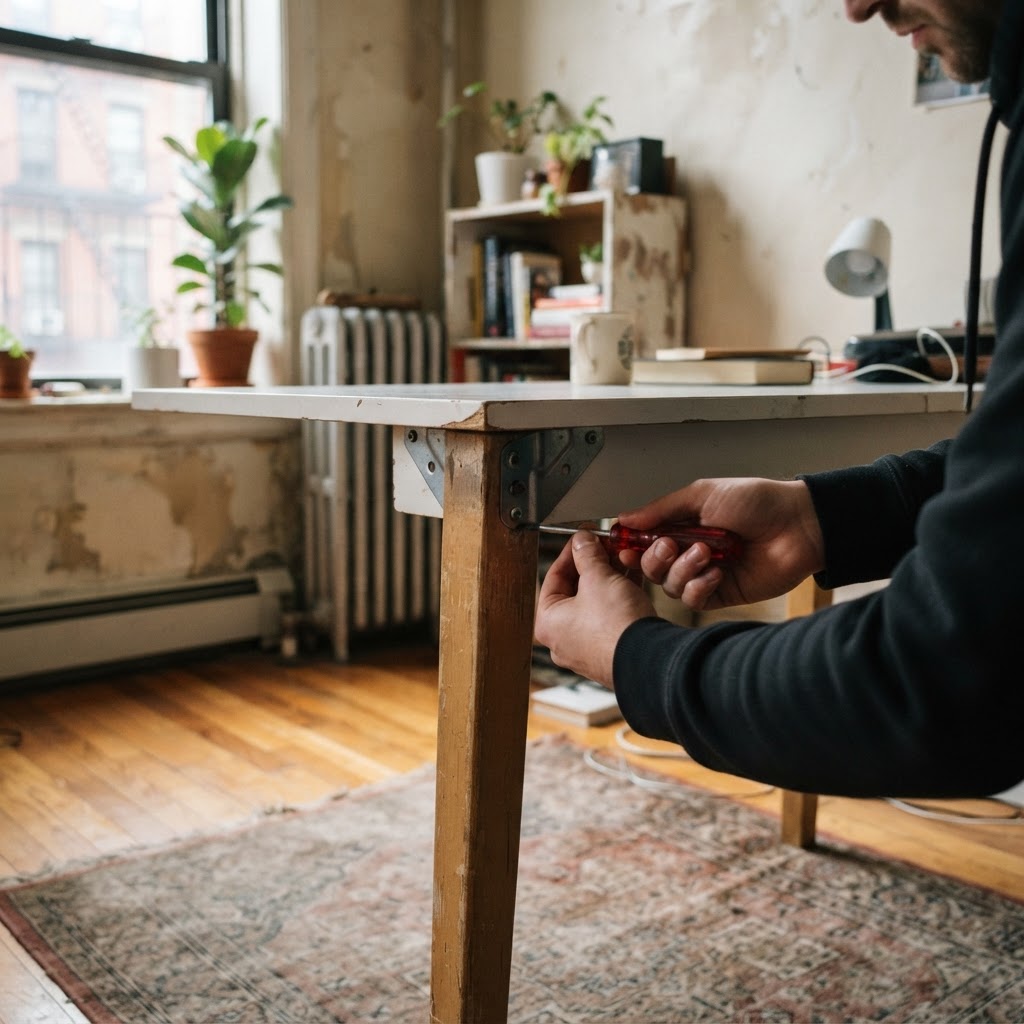
A wobbly table is more than just an annoyance. In a tight NYC studio or a pre-war brownstone, every piece of furniture needs to be solid to remain functional. If you notice your table rocking, the first step is to fix a wobbly table leg before the hardware strips or the wood frame suffers permanent damage. Most of the time, the culprit is simply loose hardware hidden under the table or an uneven floor surface common in older buildings. Ignoring the wobble causes additional stress on the remaining legs and joints, which can eventually lead to the entire table collapsing under the weight of your dinner plates or electronics.
Assess the source of the wobble
Before you reach for the toolbox, confirm exactly where the issue lies. Place the table on a known flat surface, like a stone kitchen floor. If it still rocks, the problem is with the leg or the mounting bracket. If it sits flat on the kitchen floor but wobbles in your living room, your floor has a crown or a dip, which is standard in many New York walk-ups. When testing, place your hand firmly in the center of the table and apply light pressure to each corner. If you feel a rhythmic clicking or sliding, the leg is loose or the leveling foot is not extended correctly.
If the leg itself is the problem, check the connection point. Flip the table over onto a soft rug to protect the finish. You will likely find a bolt, a cam lock, or a wooden dowel. For IKEA furniture, this is often a metal bolt threaded into a metal insert embedded in the wood. If the metal insert has pulled out or the bolt is loose, you need a targeted repair strategy. Use a flashlight to check for hairline fractures in the wood or surrounding material, as these indicate that the joint has been under tension for a long time.
Techniques to tighten and stabilize
For a standard bolt-on leg, tighten the hardware using the original Allen key. If the bolt just spins, the hole has likely stripped. Do not keep cranking it, as this will destroy the surrounding particleboard. Instead, remove the bolt and inspect the hole. If it is stripped, you can try using a slightly longer bolt or inserting a wood filler mixed with a bit of wood glue, letting it dry, and then carefully re-threading the bolt. Make sure to use a high-quality wood glue that requires a 24-hour cure time for the best bond. Always verify that the bolt length does not pierce through the top surface of the table.
If the leg is attached via a wooden dowel that has snapped, you are looking at a more complex structural repair. You may need to drill out the broken piece and install a new dowel with high-quality wood glue. If you find the structure is too damaged to support weight, it is time to stop. Do-it-yourself fixes on particleboard have limits. If you have tried to tighten the bolts and the wood is crumbling, you need to book furniture assembly to ensure the piece is structurally sound. Often, a simple metal corner bracket can reinforce a loose leg joint that has become too wide for the original hardware.
Managing New York floor irregularities
New York buildings, especially pre-war structures, are notorious for slanted floorboards and settling foundations. If your table is mechanically sound but still rocks, you must address the gap between the floor and the leg. Measure the gap at the shortest point using a small wedge or a stack of pennies. You can buy specialized felt pads or rubberized leveling feet that stick to the bottom of the leg. For a more permanent solution, use adjustable screw-in glides. These allow you to turn a small dial until the leg makes full contact with the floor, compensating for a slope of up to half an inch without needing to alter your furniture.
Maintenance for long-term stability
Furniture in small New York spaces often gets pushed, dragged, or loaded with heavy items like monitors and printers. To prevent future wobbles, perform a quarterly check of all mounting points. Take a minute to tighten every accessible bolt on your dining set or desk whenever you move your furniture for cleaning. Vibration from subway trains or nearby construction can slowly loosen even the tightest bolts over months. Applying a small drop of thread-locking fluid to the threads of your bolts can help maintain a firm grip in high-traffic areas, preventing the hardware from vibrating loose over time.
When to accept professional help
There are times when the effort outweighs the result. If your table is a high-end piece or requires custom wood shims, a handyman can handle it with the right tools. You can book a handyman to assess the structural integrity of your furniture. They can also assist with other tasks, such as book TV mounting or even a book tech setup to organize your home office. A professional will have the correct hardware and experience to ensure your furniture is safe.
Frequently Asked Questions
Why does my table wobble on my wood floor but not on my tile floor?
Many older NYC apartments have floors that are not perfectly level. If your table is fine on a flat surface but rocks in your living room, the floor is likely the issue, and you can solve it with thin felt pads or furniture shims.
Can I use a drill to tighten IKEA table legs?
Avoid using a power drill on IKEA furniture. The high torque can easily strip the holes or crack the particleboard. It is always safer to use a hand-held screwdriver or the provided Allen key to have better control.
What do I do if the metal insert fell out of the wood?
If the metal threaded insert has come loose, you can try to glue it back in using a two-part epoxy. Ensure the epoxy is rated for wood and metal, and let it cure fully for at least 24 hours before reattaching the leg.
Book help in New York
If your table needs more than a quick tightening, we are here to help. You can easily book a handyman to handle repairs across all five boroughs, Long Island, Westchester, New Jersey, and Connecticut.