
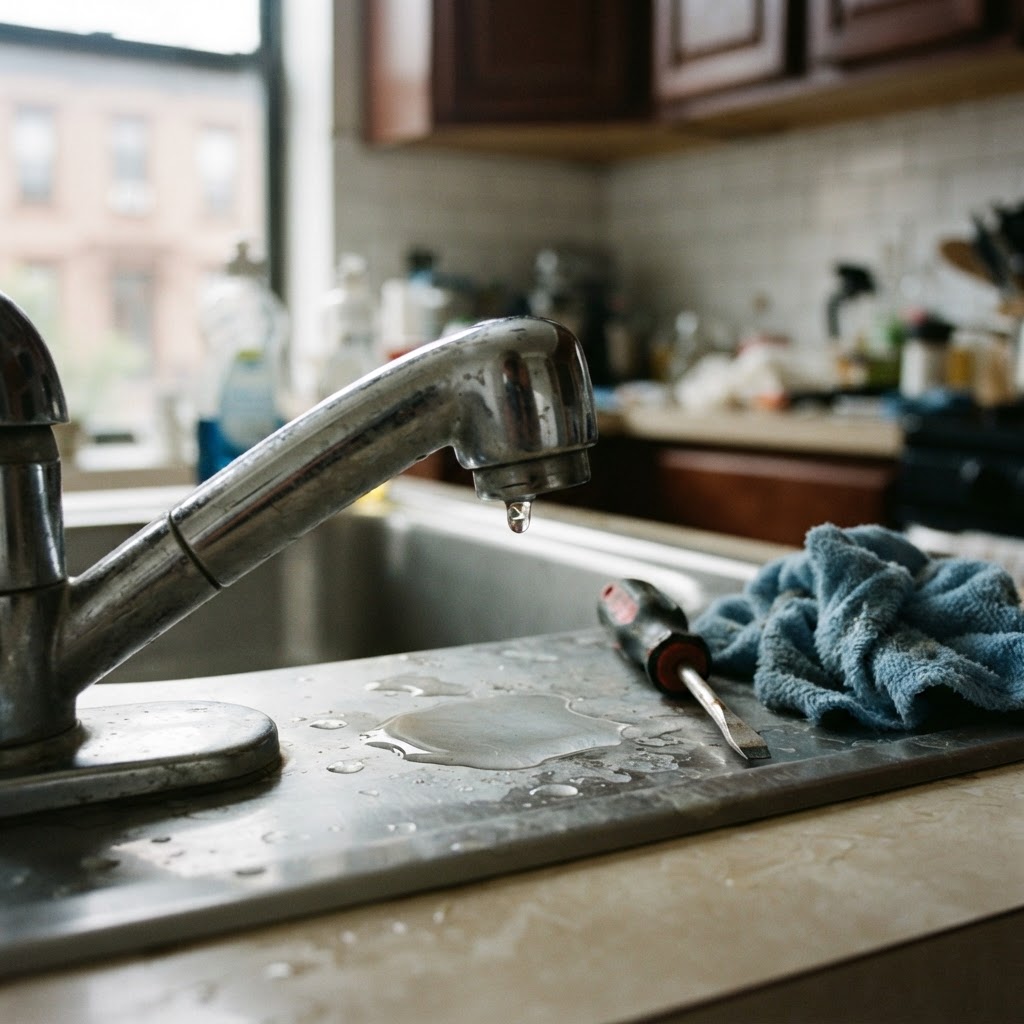
Find the leak's source before you buy parts
A faucet handle that drips when the water is off, or leaves a puddle at the base when it is on, is almost always an internal seal problem rather than a cracked body. Narrow it down first:
- Water runs only when the faucet is off: the cartridge or valve seat is worn, so it cannot close fully.
- Water appears at the base of the handle while running: a worn O-ring or cartridge seal.
- Water drips from the spout connection or under the sink: a different problem, often the spout O-ring or a loose supply connection.
Knowing which one you have determines whether a five-dollar part fixes it or you need a new faucet.
Step 1: Shut the water off properly
Under the sink you should find two supply valves, hot on the left and cold on the right. Turn them clockwise to close. If they are stuck or missing entirely, which happens in older New York apartments, shut off the water at the building or apartment main.
Open the faucet afterwards to release pressure and confirm the water is really off. Then put the drain stopper in, or lay a rag over the drain, so a tiny screw cannot disappear down the pipe.
Step 2: Identify the faucet type
Look for a brand name on the base or under the spout. Faucets generally fall into three groups: single-handle cartridge faucets, the most common in apartments and the easiest to repair; two-handle compression faucets, where each handle has its own stem with a rubber washer; and ceramic disc faucets, where parts are specific to the model.
If you cannot identify the model, take a photo of the faucet and of the cartridge once removed, then bring it to a local hardware store. Most Manhattan and Brooklyn shops will match it on the spot.
Step 3: Replace the cartridge or O-ring
For a single-handle faucet:
- Pry off the decorative cap on the handle, using a thin cloth over a flathead screwdriver to protect the finish.
- Remove the retaining screw and lift the handle off.
- Unscrew the retaining nut, then pull the cartridge straight up. Some need a cartridge puller.
- Note the orientation, then install the new cartridge the same way. Coat the O-rings with plumber's silicone grease, not petroleum jelly, which can degrade rubber.
- Reassemble, open the supply valves slowly, and check for leaks with the water running hot and cold.
For a two-handle faucet, replace the seat washer at the bottom of the stem and the O-ring on the stem body. If the valve seat inside the faucet is pitted, it needs a seat wrench and a new seat, which is fiddly work inside a tight cabinet.
Step 4: Check the connections you disturbed
Dry everything and run the water for a minute. Look at the supply lines and the base of the faucet for dampness. A slow weep at a compression fitting usually needs another quarter turn, or the ferrule has failed and should be replaced.
When to stop and call someone
Call a pro if the shut-off valves will not close or there is no valve at all, if water is coming from inside the wall or the cabinet floor, if the faucet body is cracked, or if it is a rental and the repair requires opening a wall or replacing fixtures.
Our handyman service handles cartridge replacement, supply line swaps and small plumbing repairs by the hour across NYC. If the job turns into a fixture replacement, we tell you before starting rather than after.
FAQ
How much does a faucet cartridge cost? Parts usually run $10 to $40 depending on the brand. Labor is the bigger variable if you hire it out.
Can I fix a leaky faucet without shutting off the water? No. Always shut off the supply first, or you will flood the cabinet the moment you loosen the retaining nut.
Is a dripping faucet really worth fixing? Yes. A steady drip wastes dozens of gallons a month, and the constant moisture damages the cabinet base under the sink.