
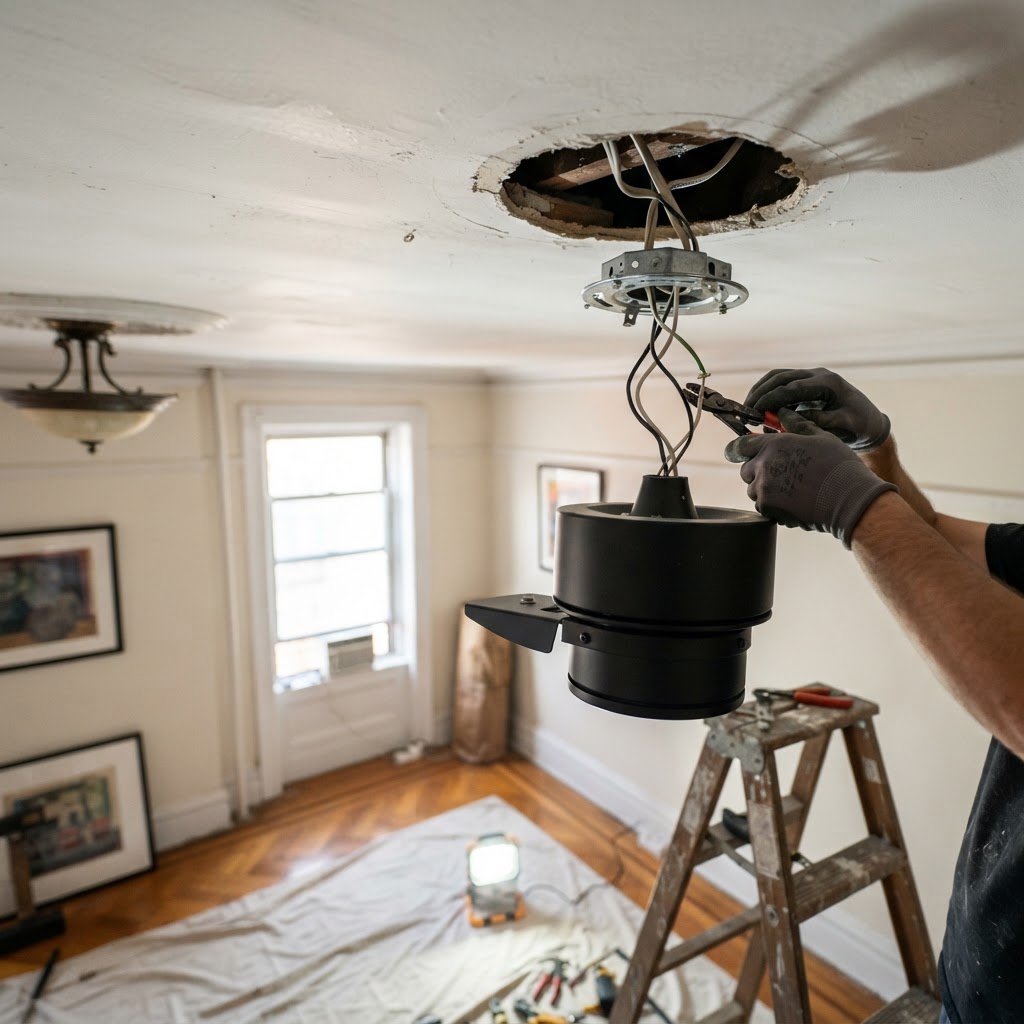
Adding a ceiling fan to a room where the builder never intended one is a common request in New York apartments. Pre-war brownstones and post-war high-rises rarely have the heavy-duty wiring or reinforced structural support needed for a rotating fan. Installing a ceiling fan in an old ceiling involves more than just swapping out a light fixture. You need to verify that your ceiling joists can support the weight and movement of the fan and that you have a rated fan box securely attached to the structural frame of your building.
Understanding the structural requirements
Before you start, you must understand that a standard light fixture box is not designed to hold a ceiling fan. Fans create dynamic weight and vibration that can pull a standard plastic or light-gauge metal box right out of your drywall. In a typical NYC building, you likely have wood joists or, in some newer buildings, steel channels. You must secure a fan-rated brace directly to these structural elements. When installing a heavy fan, you need to ensure the box is rated for at least 70 pounds. Vibration over time will loosen poorly secured components, leading to wobbling or catastrophic failure.
Accessing the ceiling cavity
In many apartments, you will need to cut into the ceiling to reach the joists. If you are dealing with a lath and plaster ceiling, this is a messy and delicate process that often requires patching and professional painting afterward. For those in co-ops or condos, you must check your building bylaws. Many boards require a Certificate of Insurance, or COI, before any invasive work begins. If your building requires a licensed electrician to sign off on structural penetrations, you should book a handyman to evaluate your specific ceiling type before picking up a saw. Use a stud finder to locate joist spacing, which is typically 16 inches on center in older NYC residential buildings.
Choosing the right fan-rated box
Head to the hardware store and look for a fan-rated brace box. These bars expand to span the distance between two joists. You slide the bar through the hole in your ceiling, twist it to lock it against the wood, and then bolt the junction box onto the bar. If you find your ceiling is made of concrete, the DIY route is essentially impossible for a homeowner. You cannot easily install a brace in a concrete slab ceiling without specialized masonry tools and core drilling experience. In these cases, it is much safer to book TV mounting or other services and let a professional handle the complex ceiling work. Always use a level to ensure the bracket is flush, as even a slight tilt will cause the fan to oscillate violently at high speeds.
Navigating NYC building rules and timing
Before beginning, verify your building's rules regarding ceiling modifications. Many NYC co-ops classify ceiling work as a renovation that requires an Alteration Agreement. This ensures that you are not hitting plumbing lines or electrical conduits that may be running through the joist space above your drywall. Schedule your work during designated weekday hours, typically between 9:00 AM and 4:00 PM, to avoid noise complaints from neighbors. If you need to shut off power to your line, notify your neighbors in advance if your panel is shared or located in a hallway. Always confirm if your building management requires a master electrician's sign-off for electrical box replacements.
Maintenance and long-term care
After installation, perform a vibration test on the highest setting. If the fan wobbles, check the blade alignment. Use a measuring tape to ensure each blade tip is the exact same distance from the ceiling. A common issue is debris or dust accumulation on the top of the blades, which throws the fan off-balance over time. Clean blades every three months to prevent heavy buildup. If the fan starts making a clicking sound, check the mounting hardware. Vibration can sometimes cause the mounting screws to back out slightly. A simple tightening of the canopy screws usually fixes the issue. If the fan continues to hum or click, the internal motor bearings may be failing, which is a sign you should contact a professional.
Wiring and safety precautions
Once the box is secure, you need to handle the electrical wiring. You should already have a standard power supply for your existing light. However, many older NYC apartments have two-wire systems without a dedicated ground wire. Ceiling fans require a grounded circuit for safety. If you do not see a copper or green wire in your existing light box, you may need to run new Romex cable back to your breaker panel. This is the point where DIY ends for most people. Always turn off the power at the main breaker panel and use a non-contact voltage tester to verify the line is dead before touching any wires.
When to stop and call a pro
If you find that your ceiling joists are running in the wrong direction, or if you encounter fire blocking or existing plumbing pipes during your ceiling cut, stop immediately. Wiring and structural modifications in NYC buildings are heavily regulated. You also need to ensure that the fan you bought is rated for the size of your room. If you struggle with the technical setup, you might consider booking a tech setup for your smart home controls after the physical installation is complete. If you are also planning to upgrade other parts of the room, we can help with furniture assembly to clear the space for your project.
Frequently Asked Questions
Can I install a ceiling fan in a concrete ceiling?
Installing a ceiling fan into a concrete slab is dangerous and requires specialized equipment. You cannot use standard wood-joist brace boxes in concrete, so you should hire a professional to ensure the anchoring is code-compliant.
What do I do if I have a lath and plaster ceiling?
These ceilings are brittle and prone to cracking. You must cut very carefully and be prepared to patch, sand, and paint the surrounding area after the fan is securely mounted.
How much does it cost to have a pro do this?
For general handyman tasks like fixture installation or light repairs, our rate is $85/hour. The total cost depends on the complexity of your ceiling and whether new wiring is required.
Book help in New York
If the project seems overwhelming or your building requires professional insurance and certification, we are ready to assist. You can reach out to our team to book a handyman for your next home project.