
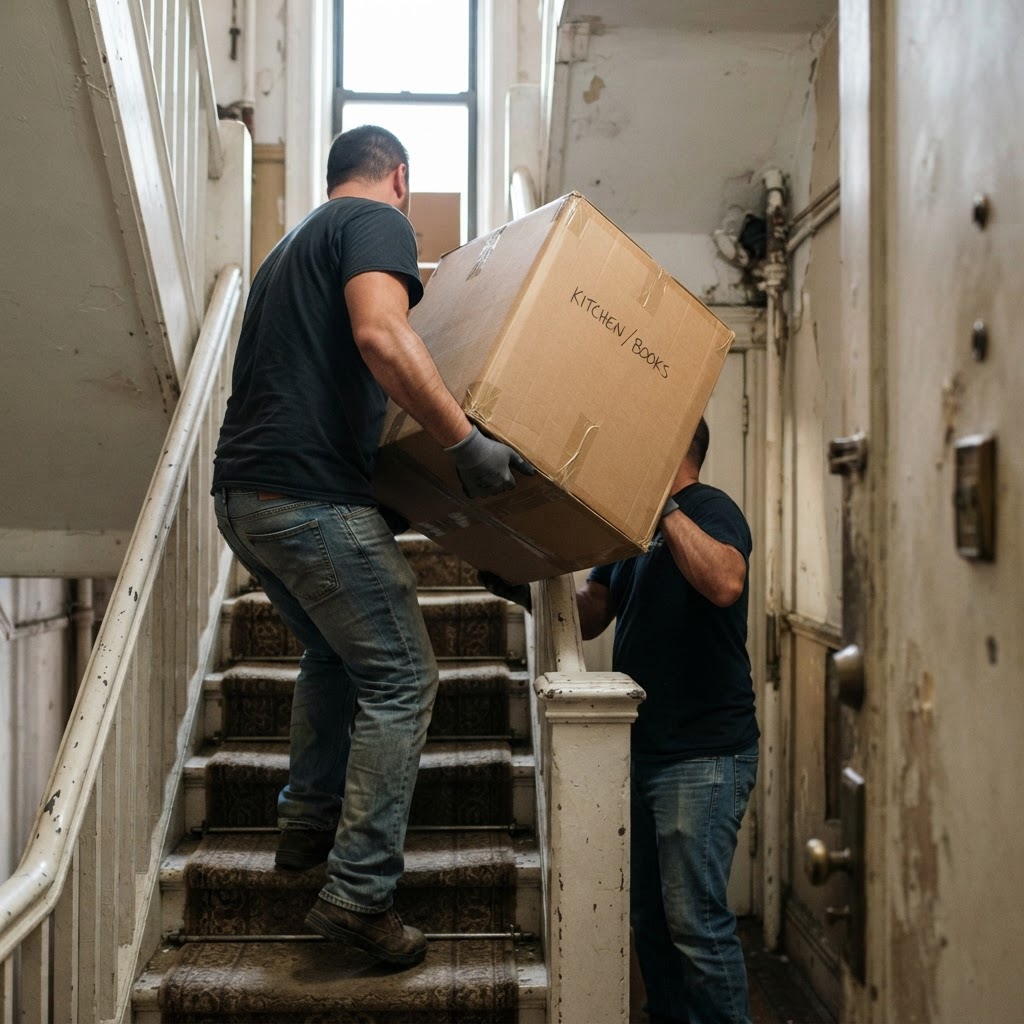
Moving in New York City is rarely straightforward. If you live in a building without an elevator, you are likely wondering why your walk-up apartment moving cost seems higher than a standard move. The physical demand of carrying heavy furniture up and down narrow, winding staircases is the primary driver of these costs. It takes longer to navigate a pre-war staircase than it does to wheel a dolly onto a freight elevator, and time is the main unit of measurement in professional moving labor.
The reality of walk-up logistics
When a moving crew arrives at a five-story walk-up in Brooklyn or a brownstone in Manhattan, the physical labor involved is intense. Unlike elevator buildings where items can be moved in batches, walk-ups require a steady, labor-intensive flow. Movers must account for the limited landing space, the risk of damage to narrow door frames, and the physical toll of repeating those flights multiple times. Movers generally aim to clear one floor every fifteen to twenty minutes depending on the weight of the items. They must also use specific techniques like pivoting long sofas vertically through narrow stairwells. Common issues include landing corners that are too tight for mattresses or low ceilings that prevent upright maneuvering. The fix usually involves removing doors from hinges or taking apart bed frames entirely to create space.
How time impacts your budget
Hourly rates are the industry standard for local moves. At NYC Pro Tasker, moving labor is priced at $65/hour for one mover or $160/hour for two movers, with a 2-hour minimum. Because walking up and down stairs takes significantly more time than horizontal transport, you should expect the total clock time to be higher. If you want a quick estimate for your specific situation, check our instant price estimate tool to see how your building type affects the total. A good rule of thumb is to add one hour to your estimate for every two flights of stairs in your building.
Preparing your items for the stairs
To keep costs down, the best thing you can do is prepare ahead of time. Professional movers move faster when they aren't waiting for you to finish packing boxes or taking apart furniture. If you have large pieces, you should disassemble furniture for moving before the team arrives. When furniture is in smaller, manageable sections, it is easier to navigate tight stairwells without dings or damage to your walls. Use heavy-duty packing tape for box bottoms and ensure every box weighs under fifty pounds. Label boxes by room so movers do not have to ask you where items go during the transit process.
Managing building rules and COIs
New York buildings are notoriously strict about move-in procedures. Many co-ops and condos require a Certificate of Insurance, or COI, before allowing any commercial movers into the building. You must request this from the moving company at least one week in advance. Ensure you have the exact requirements from your building manager, including the specific liability amounts. Additionally, many buildings mandate that you protect common areas with masonite or floor runners. If you fail to have these materials, management might stop the move entirely, forcing you to pay for extra labor hours while you scramble to find supplies. Always check your lease for move-in hour restrictions, as some buildings only allow moving on weekdays between nine and five.
Minimizing costs through strategic planning
Moving costs are highly sensitive to the duration of the labor. You can significantly reduce your bill by optimizing the sequence of the move. Start by staging all loose items near the front door. This prevents movers from spending time walking through the apartment searching for smaller boxes. If you live on a narrow street, coordinate with neighbors to keep the loading zone clear for the truck. Every ten feet of distance between the building entrance and the truck adds to the time. If you own an item that requires specialized handling, such as a marble tabletop or a large mirror, have it crated or wrapped in moving blankets before the team touches it. This proactive preparation protects your items and keeps the crew moving at a steady, productive pace.
Factors that influence your moving bill
Beyond just the number of stairs, several other New York-specific factors play a role in your final price. Building management often dictates the rules, especially in co-ops and condos. If your building requires a Certificate of Insurance, or COI, you need to request that well in advance. Other factors include the proximity of the moving truck to the entrance. In congested areas, the distance from the curb to the front door can add hours to a job. If you are worried about the scope of the work, you can always book moving help with professionals who are accustomed to the unique challenges of NYC architecture.
Planning a smooth transition
Budgeting for a move is about more than just the movers. You might also find yourself needing furniture assembly cost information if you plan to buy new items for your place or if you need help putting your bed back together after the move. Having a clear plan for your move day, including reserved parking for the truck if possible, helps avoid unnecessary extra hours. If your moving day reveals other needs like wall repairs or hanging fixtures, remember that you can book a handyman to handle those finishing touches once you are settled in.
Frequently Asked Questions
Why does living on a higher floor cost more?
Moving items to higher floors increases the duration of the labor because movers have to navigate more staircases. Since labor is calculated by the hour, more time spent climbing translates to a higher total bill compared to a first-floor or elevator building move.
Should I clear the hallways before the movers arrive?
Yes, clearing hallways and common areas is essential. A clean, unobstructed path allows the movers to move efficiently, reducing the risk of damage and keeping your move within the planned timeframe.
Do movers charge more for heavy items in a walk-up?
Extremely heavy items like solid wood armoires or large appliances may require more movers or extra time to navigate safely. It is best to mention these items when you book so you have the correct number of crew members on-site to avoid delays.
Book help in New York
We provide professional, insured labor for moves across all five boroughs, Long Island, Westchester, New Jersey, and Connecticut. Get started with your move today by visiting our instant price estimate page.